


Research in the PSMM Lab

Dynamic polymers host covalently adaptable or physical bonds whose association and dissociation enable network restructuring, begetting viscoelasticity and self-healing. Both network models and physically motivated constitutive models are able to reproduce the mechanical stress responses of these systems. Wagner, et al. Soft Matter (2021)
"Active" materials are those comprised of constituents that convert locally stored energy into mechanical work, allowing them to climb energy gradients and generate stresses.

Fire ant (S. invicta) workers form rafts by linking to one another to survive floods. The resulting aggregations are exemplary condensed active materials, as every ant is capable of doing mechanical work to self-propel or generate internal aggregate stresses. Biomimetic, agent-based models are able to reproduce the spontaneous formation of activity-dependent, tether-like protrusions via simple, local interaction rules. Wagner, et al. JRSI (2021), Wagner & Vernerey, PLOS Comp. Bio. (2022)
Interests: Our research centers on the emergent mechanics of dynamic and active soft materials.
"Dynamic" materials are those cohered by bonds that can break and reform reversibly, allowing them to internally restructure and globally reshape.
Dynamic bonds, alone, are essential to the development of adhesives, resorbable biomaterials, re-processable polymers, and a wide array of other adaptive systems. Yet, when imbued with activity, dynamically bonded constituents are also capable of achieving spontaneously emergent, complex tasks. Indeed, dynamic bonds and activity are joint prerequisites to functions exhibited by life across length scales, such as highly structured self-assembly, collective motility, mediated self-healing, and growth/morphogenesis. Thus, harnessing these features within engineered systems is paramount for the fruition of smart, autonomously adaptive materials.
To improve our understanding and design of such materials, I map the mechanical traits of dynamic/active materials to their constituents' local behaviors. I focus on the flexible development and application of new, physically motivated computational material models. My approach allows me to rapidly explore a diverse array of dynamic and active systems ranging from transient gels with prospects in tissue engineering to aggregations of insects that may inspire condensed swarm robotics.
Mesoscale modeling of dynamic polymers
The "meso"- or "between"-scale generally refers to the spatiotemporal regimes below the macroscale at which most experimental characterization takes place and homogenized continuum models are appropriate, but above the elemental scales at which quantum mechanical (QM) and molecular dynamics (MD) predictions are viable. Material characteristics are notoriously difficult to probe across the several decades comprising the mesoscale, especially during processes that evolve microstructure such as mechanical loading. However, for materials with hierarchical structures and timescales – such as polymeric elastomers, gels, and living tissues – discerning mesoscale phenomena is essential for relating microscale causes to macroscale effects and achieving ab initio predictive material design. Therefore, a large portion of my research focuses on the development of new coarse-graining methods rooted in first principle physics. These methods preserve detailed information about microstructure that is crucial for evolving networks undergoing damage or dynamic bond exchange. Yet they drastically reduce computational cost to permit model predictions at the spatiotemporal domains between those of existing methods. To ensure consistency across scales, I validate my models against a combination of MD models predictions, constitutive theory, and experimental results.

Mesoscale models "bridge the gap" between macroscale and microscale phenomena. However, the "mesoscale" for polymeric materials such as gels generally comprises four to six decades of length scale (i.e., 1e-8 to 1e-5 m) and time scale (i.e., 1e-8 to 1e-3 s) each. Consequently, the development of suitable mesoscale methods for polymeric materials is an important and ongoing area of research. Wagner, et al. JMPS (2022),
Click images below to learn more!


Unveiling the rules of active matter
Through local drops in entropy and violation of detailed balance, active materials are intrinsically capable of functions that other materials cannot achieve without externally introduced gradients. However, this violation of thermodynamic consistency at material scales (i.e., without accounting for the chemically stored energy within constituents) renders active materials particularly difficult to model constitutively. This difficulty is exacerbated by the propensity of active particles to dynamically exchange neighbors, phase separate, align, and generate steep internal stress gradients depending on their conditions. Therefore, in studying active systems, I have taken a combined experimental and computational modeling approach. To date, I have conducted studies on the morphogenesis and mechanical response of rafts comprised of fire ants (S. invicta). Using a combination of numerically implemented toy models and agent-based discrete particle methods, I have unveiled sets of local interaction rules between ants that predict the spontaneous emergence of exploratory protrusions and provide evidence of force-stabilizing catch bond kinetics in perturbed raft structures. Significantly, these rules exclude long-range interactions or centralized control, exemplifying how relatively simple agents can drive complex emergent phenomena without complex communication.
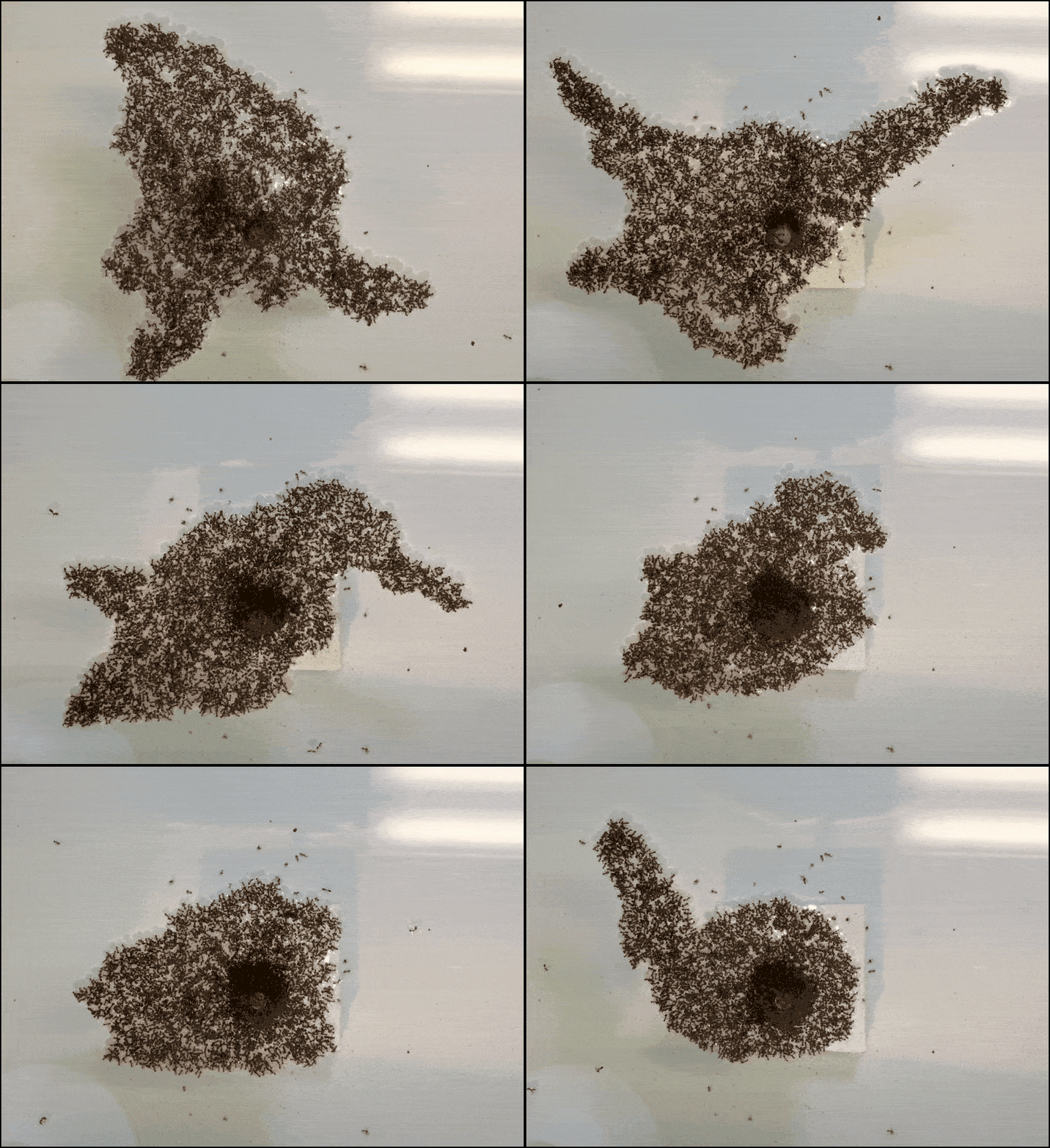
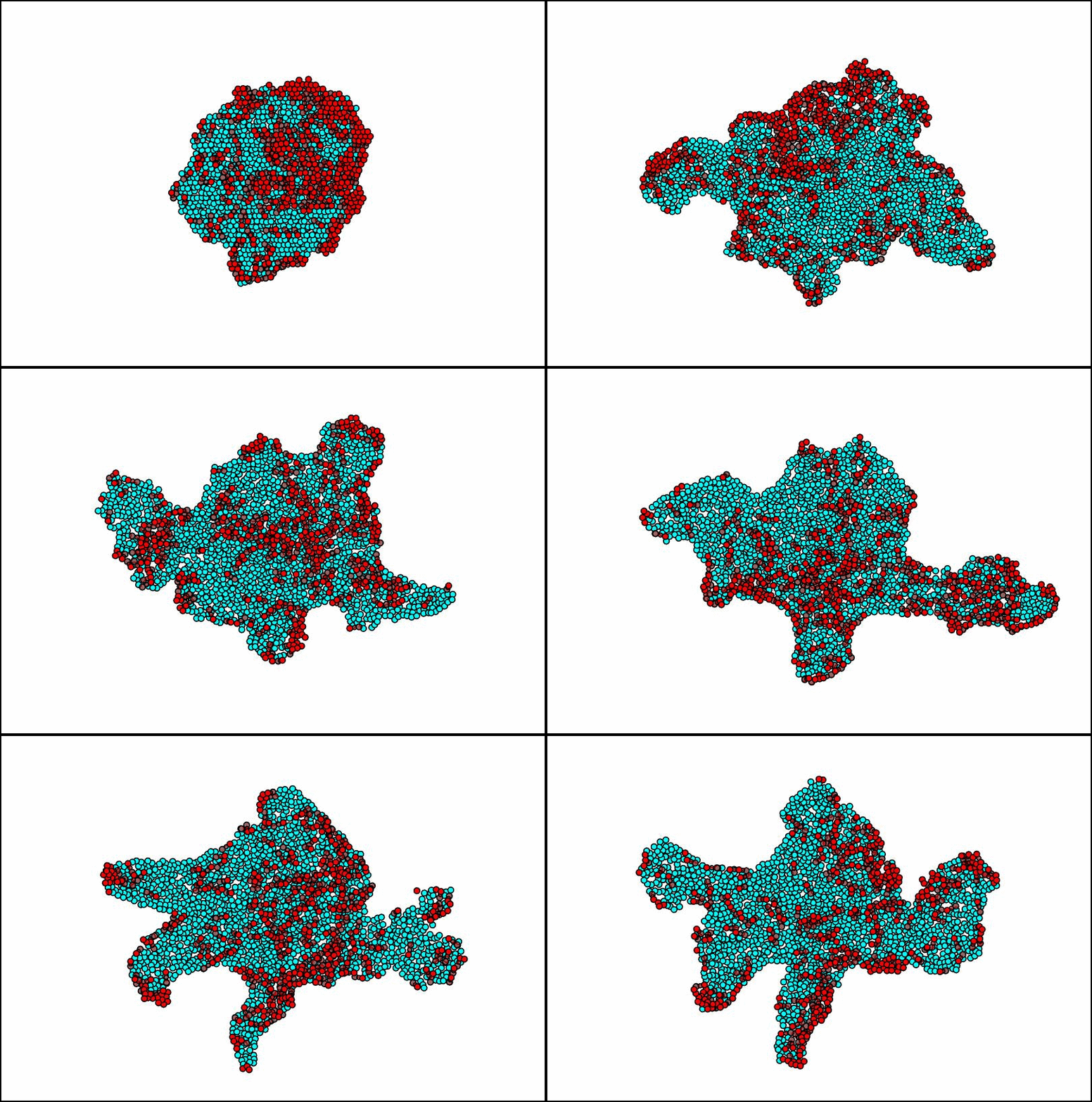
Top back: A timelapsed top view of a fire ant raft over a roughly 4 -hour duration shows how these condensed active systems continually change shape via a recycling process of "treadmilling". Treadmilling further enables the sprouting, growth, and retraction of tether-like protrusions that ants can use to escape flood waters. Bottom front: Agent-based models, like that shown, lump physical and effective interactions (e.g., "social forces") into energetic potentials and heuristic rules that govern the "decision-making" of each individual agent. If set properly, these rules can reproduce spontaneous functions such as the treadmilling and spontaneous protrusion growth observed above. By testing different rules and perturbing the parameters that govern them, agent-based models are useful tools for sussing out likely explanations of emergent functional behaviors. Here, we found that morphology is mediated by the active self-propulsion force of pedestrian ants (red) that walk on top of the condensed ants (blue) comprising the raft structure. Wagner, et al. JRSI (2021), Wagner & Vernerey. PLOS Comp. Bio. (2022)


